SUMMARY
Circumcision versus Lack of Circumcision
Lack of circumcision:
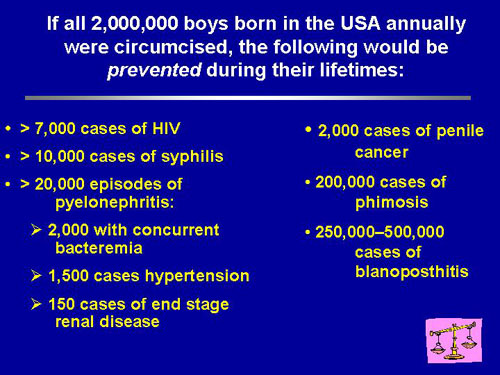
• Is responsible for a 10-fold higher risk of urinary tract infections in infancy. Risk = 1 in 20 to 1 in 50 for uncircumcised infants and 1 in 200 to 1 in 500 for circumcised infants. Higher risk of UTI at older ages as well. Overall lifetime cumulative prevalence of UTI = 1 in 3 for uncircumcised males compared with 1 in 12 for circumcised males, respectively.
• Confers a higher risk of death in the first year of life (from complications of urinary tract infections: namely kidney failure, meningitis and infection of bone marrow).
• One in ~400–900 uncircumcised men will get cancer of the penis, which occurs more than 20 times more commonly in uncircumcised men. A quarter of these will die from it and the rest will require complete or partial penile amputation as a result. (In contrast, invasive penile cancer never occurs or is extraordinarily rare in men circumcised at birth.) (Data from studies in the USA, Denmark and Australia, which are not to be confused with the often quoted, but misleading, annual incidence figure of 1 in 100,000).
• Higher risk of prostate cancer (50–100% higher in uncircumcised men)
• Is associated with 3-fold higher risk of inflammation and infection of the skin of the penis. This includes balanitis (inflammation of the glans), posthitis (inflammation of the foreskin), balanoposthitis (inflammation of glans and foreskin), phimosis (inability to retract the foreskin) and paraphimosis (constriction of the penis by a tight foreskin that will not return after retraction). Up to 18% of uncircumcised boys will develop one of these by 8 years of age, whereas all are unknown or much rarer in the circumcised. Risk of balanoposthitis = 1 in 6. Obstruction to urine flow = 1 in 10–50. Risk of these is even higher in diabetic men.
• Means increased risk of problems that may necessitate 1 in 10 older children and men requiring circumcision later in life, when the cost is 10 times higher, the procedure is less convenient, and the cosmetic result can be not as good, as stitches or tissue glue are required, as compared with circumcisions done in infancy.
• Increases by 2–4 fold the risk of thrush and sexually transmitted infections such as human papillomavirus (HPV), genital herpes (HSV-2), syphilis, chancroid, Trichomonas vaginalis mycoplasma and thrush.
• Is the biggest risk factor for heterosexually-acquired AIDS virus infection in men. 2 to 8-times higher risk by itself, and even higher when lesions from STIs are added in. Risk per exposure = 1 in 300.
• In the female partners of uncircumcised men lack of male circumcision is associated with an up to 5 fold higher incidence of cervical cancer (caused by sexually transmitted HPV), genital herpes, Trichomonas vaginalis, bacterial vaginosis (formerly called “Gardnerella”), and possibly Chlamydia (which is a cause of pelvic inflammatory disease, infertility from blockage of fallopian tubes, and ectopic pregnancy).
Getting circumcised will result in:
• Having to go through a very minor surgical procedure that carries with it small risks.
• Improved hygiene.
• Much lower risk of urinary tract infections.
• Much lower chance of acquiring HIV, the AIDS virus, heterosexually.
• Virtually complete elimination of the risk of invasive penile cancer.
• Slightly lower risk of prostate cancer.
• More favourable hygiene for the man’s sexual partner.
• Much lower risk of cervical cancer and Chlamydia (and thus infertility and other problems) in the female sexual partner, as well as lower risk to her of various other STIs, greater partner sexual pleasure, penile attractiveness and hygiene.
• More favorable sexual function and experience, with no reduction in sensation during arousal or in the sensitivity of the flaccid penis.
• A penis that is regarded by most men and women as being more attractive.